|
Dates
|
Online Gallery
|
|
2 September - 31 October
2026 |
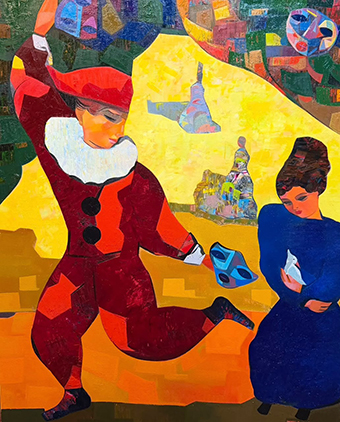 Igor Tcholaria
-
the exhibition
'Golden Foxtrot Of Autumn' of the latest works
by Igor Tcholaria. Igor Tcholaria
-
the exhibition
'Golden Foxtrot Of Autumn' of the latest works
by Igor Tcholaria.
Igor Tcholaria
is an artist, a graduate of the Leningrad Art
Academy named after Mukhina, an honorary member
of the Russian Academy of Arts. He has travelled
from the small town of Ochamchiri on the Black
Sea coast to the largest galleries in Moscow,
London, Brussels, New York, Amsterdam, and
Utrecht.
Never ceasing
to study, he has deeply mastered the entire
spectrum of world art, from the old masters,
French impressionists and modernists, to modern
movements, where the thoughtful message often
plays a greater role than the image itself. At
the same time, he does not play at postmodernism
with its cold parody of old or recent classics.
Tcholaria uses immersion in art history to
maximize, often spontaneous, expression of
emotion and instantaneous vision. This is a
special talent. The great masters of bel canto
work in a similar way. The ease of singing is
achieved through exceptional technique,
developed over decades of work. Pavarotti sings
like he breathes. Tcholaria paints as if he were
breathing. Therefore, looking at his art, the
viewer also breathes easier.
At the same
time, if you take a closer look at the artist’s
work, you can identify several main directions.
Firstly, it is a portrait and Modigliani comes
to the viewer's mind. The elongated necks of
beautiful women seem to hint at this. But if you
look closely, you simultaneously feel the gentle
power of Raphael, the sublime detachment of
Russian icons and the clear lines of Georgian
coinage, which has its origins in Iranian
miniatures. Tcholaria managed to synthesize and
melt various ideas and directions in his inner
crucible. A new quality of image emerged,
instantly recognizable as his unique style.
Initially, the
artist was fascinated by the circus theme, where
the characters of the Italian comedy Del Arte
Harlequins and Colombinas also acted. They
freely mastered the space of his imagination,
allowing the author to fully realize the power
of his pictorial potential. He is also
fascinated by the ideas of modern circus action
in the spirit of the grandiose Cirque Du Soleil,
where acrobatics degenerates into a kaleidoscope
on a cosmic scale. Russian buffoons with their
golden bells of fair fun fit into this theme no
less organically.
If you think
about it, it’s easy to see that the real
avant-garde is archaic. Picasso's bull is
accurately scaled from a rock painting. The
primitive genius echoes across the modern
context thousands of years later. In a
philosophical sense, Tcholaria's works clearly
combine Apollonian and Dionysian motifs. Many
portraits and landscapes set a calm,
contemplative mood, which, according to
Nietzsche’s classification, is the theme of
Apollo. The expressive compositions are
organized by the carousel vortices of Dionysius.
In other
words, Tcholaria’s work is unusually artistic.
The abundance of masks on his canvases creates
an additional theatrical effect. The author acts
not only as a painter, but also as a director of
a passionate extravaganza, where Dionysius and
Apollo are presented in harmonious unity.
The surreal
motif also gives a unique sound to Tcholaria’s
landscapes. Quite traditional in content, they
demonstrate a completely fresh and deep look at
familiar reality. You can’t help but remember
Blok’s line - and again the world will appear
strange, shrouded in a coloured fog...
Many
collectors note the positive energy emanating
from his paintings. It is not for nothing that
Tcholaria’s works are in the collections of such
art connoisseurs as Pavarotti, designer John
Galliano, singer Madonna, the outstanding hockey
player Mogilny, the most popular French actors
Pierre Richard and Gerard Depardieu, and the
tamer of the silent lambs Anthony Hopkins.
Having made
wide turns in European time and space, Tcholaria
received an invitation and in 2022 held a large
retrospective exhibition at the State Russian
Museum of St. Petersburg.
|
|
2 July - 31 August 2026 |
 Ashkal
- Ashkal
-
the exhibition
"Contemporary Echoes" of the latest works by
Naveed Akhtar (ASHKAL).
"I see my practice as a visual dialogue where
history, memory, and contemporary experience
interact with one another. For me, painting is
not simply about creating images it is about
re-examining existing imagery, transforming it,
and generating new meanings through it. Through
contemporary painting, I explore the emotional
and psychological layers that images accumulate
over time.
I
work across different mediums particularly
charcoal, acrylic, and mixed media on canvas
because each medium carries its own energy and
visual language. Charcoal, for me, represents
memory and shadow, while acrylic introduces
intensity, movement, and disruption. Through the
combination of these materials, I create
surfaces that feel both raw and controlled at
the same time.
My recent body of work, “Contemporary
Echoes,” is based on transforming the imagery of
Western Old Masters into a contemporary context.
Rather than directly reproducing classical
paintings, I deconstruct, distort, and
reconstruct them so they can exist within
today’s visual and cultural environment in a new
form. In my work, historical imagery appears
like memory itself sometimes clear, sometimes
fragmented, and sometimes almost erased. This
transformation is not only a stylistic process
for me, but also a conceptual investigation into
how historical images continue to survive within
our collective consciousness.
Experimentation with the physical surface of the
canvas is an essential part of my practice.
Layering, scraping, erasing, and rebuilding are
central to my process. I want each work to carry
evidence of its own making traces of time,
unfinished marks, and hidden histories. For me,
painting is never a fixed image; it is an
evolving space where destruction and creation
exist simultaneously.
My work also engages with ideas of identity,
cultural inheritance, and image consumption. In
today’s hyper-visual and digitally saturated
world, we constantly exist among reproduced
images, and I am interested in exploring how
classical visual language can still generate new
meanings within a fragmented contemporary
reality.
Ultimately, my
practice is not about preserving the past, but
about reawakening it. Through my paintings, I
aim to create a bridge between history and
contemporary reality a space where familiar
imagery can re-emerge in a new emotional and
conceptual form." - ASHKAL
|
|
2 May - 30 June 2026 |
 Auguste Rodin - Auguste Rodin -
D'Airain Collection, posthumous cast bronzes
from the foundry plasters at Guastini Foundry,
Italy, 1999-2000.
François-Auguste-René Rodin (12
November 1840 – 17 November 1917), known as Auguste Rodin was a
French sculptor. Although Rodin is generally considered the
progenitor of modern sculpture, he did not set out to rebel against the past. He was schooled traditionally, took a craftsman-like approach to his work, and desired academic recognition, although he was never accepted into Paris's foremost school of art.
Sculpturally, Rodin possessed a unique ability to model a complex, turbulent, deeply pocketed surface in clay. Many of his most notable sculptures were roundly criticized during his lifetime. They clashed with the predominant figure sculpture tradition, in which works were decorative, formulaic, or highly thematic. Rodin's most original work departed from traditional themes of mythology and allegory, modelled the human body with realism, and celebrated individual character and physicality. Rodin was sensitive of the controversy surrounding his work, but refused to change his style.
Auguste Rodin is generally recognized as the
most important sculptor of the nineteenth century. His innovations
in form and subject matter established his reputation as the first
master of modern sculpture. Straying from nineteenth-century
academic conventions, Rodin created his own sense of personal
artistic expressions that focused on the vitality of the human
spirit. His modelling techniques captured the movement and depth of
emotion of his subjects by altering traditional poses and gestures.
|
|
2 March - 30 April 2026 |
 Patrick Altes
-
the exhibition
"Drawing
The Journey" of the latest works by
the artist. Patrick Altes
-
the exhibition
"Drawing
The Journey" of the latest works by
the artist.
Patrick Altes is an artist of
French/Spanish origins, whose work has been
deeply informed by his own personal history.
Born in Algeria, he has made a distinctive
contribution to the postcolonial discourse and
the emerging Franco-Algerian art movement. As a
young adult, he lived in South Africa for two
years under the apartheid.
He was working at the University of Fort Hare, a
key institution in higher education for black
Africans, which counted among its former
students a number of prominent leading opponents
of the apartheid. This was his first-hand
experience of a society based on discrimination,
repression and deprivation of civil and
political rights for a large part of the
population. It deeply marked him and fuelled in
him a sense for the politically, socially and
humanly acceptable.
"Tolerance", his latest major exhibition at
Gerald Moore Gallery, addresses the political
and cultural changes that are unfolding across
the UK and the world today. It confronts
negative cultural stereotypes and advocates for
tolerance and respect in times of angst,
division and separatism. With perilous journeys
depositing migrants on European - and now,
British - shores, Altes turns his attention to
the harrowing circumstances that increasingly
accompany migration and resettlement.
He is interested in the evolving relationship
between the contemporary world and our deeper
humanity.
|
|
2 January - 28 February 2026 |
 Victoria Kovalenchikova
-
the exhibition
"The World Is Yours" of the latest works by
the artist. Victoria Kovalenchikova
-
the exhibition
"The World Is Yours" of the latest works by
the artist.
Kovalenchikova's Earth series
takes the long view of our home from the skies.
Her mixed media canvases incorporate found
discarded, broken glass embedded into her
textured surfaces. The bold use of oils radiates
the colours of each continent. Marbled effects,
fragments of reflected light and resin come
together with other diverse materials to create
unique sculptural paintings. “I try to bring the
textures of the planet alive.”
Born in Belarus in 1978 Victoria Kovalenchikova
lives and works in Holland, regularly exhibiting
across the world. |
|
 home
about
artists
exhibitions press
contact
purchase
home
about
artists
exhibitions press
contact
purchase


